
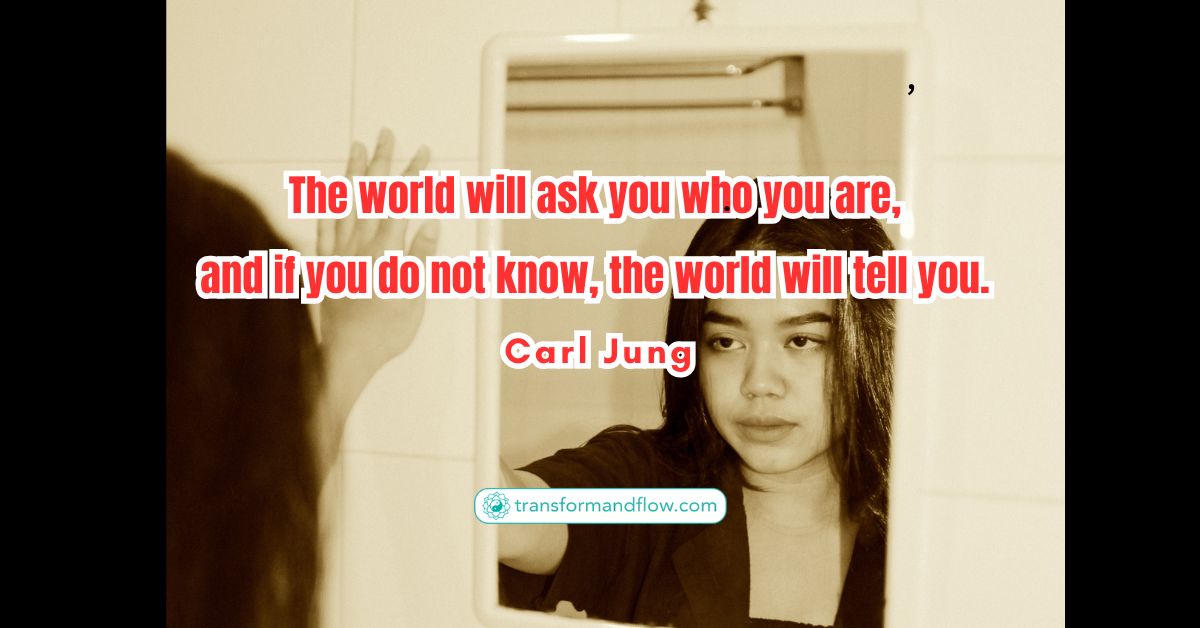
There is a famous quote by a Swiss psychologist that acts like a quiet warning for the first half of our lives, and a loud alarm for the second.
The world will ask you who you are, and if you do not know, the world will tell you. Carl Jung
When we are young, we hear these words and think they are about identity or “finding ourselves,” as if our identity were a set of keys lost behind the sofa. But as adults, we come to realize that Jung wasn’t talking about a search; he was talking about a struggle. He was talking about the silent, daily battle between the person you were born to be and the person the world demands you to be.
For most of us, we lose this battle without even realizing we are fighting it. We get lost in the “busyness” of adulthood – the career ladders, the mortgage payments, the social obligations – only to wake up one day, often triggered by a crisis, and realize that years have slipped away. We look in the mirror and realize we are wearing a costume designed by committee.
The Architecture of the “Auto-Pilot” Life
Why is it so easy to lose ourselves? It’s because the “world” is incredibly efficient at providing templates. From the moment we enter the workforce, society hands us a pre-packaged version of “The Successful Adult.”
This template usually involves:
- Constant Productivity: The idea that if you aren’t working, earning, or improving, you are wasting time.
- Social Comparison: The drive to match the lifestyle of our peers, our neighbors, or the curated lives we see on social media.
- The “Next Step” Fallacy: The belief that happiness is always one milestone away – the next promotion, the next house, the next vacation.
When we follow this template, we enter a state of “auto-pilot.” Our days become a series of reactions. We react to emails, we react to the news, we react to the demands of our families and bosses. We feel like we are moving fast, so we assume we are moving forward. But as many of us eventually discover, you can run a marathon on a treadmill and still end up exactly where you started.
In this state of busyness, the world is constantly “telling you who you are.” It tells you that you are your job title. It tells you that your value is tied to your bank account. It tells you that your worth is measured by how much you can do for others. And because you are too tired to argue, you accept these definitions. You become the person the world needs you to be, rather than the person you actually are.
The Breaking Point: Facing the Challenge
Most people don’t change because they see the light; they change because they feel the heat.
The realization that life has slipped away rarely happens during a quiet moment of meditation. It usually happens when the “auto-pilot” system breaks down. This is the challenge – the moment of crisis that forces the world to stop talking for a second so you can finally hear yourself.
This challenge could be anything:
- A health scare that reminds you that your body is not a machine.
- A career setback that proves the company you gave your life to doesn’t actually love you back.
- The loss of a relationship that was the primary mirror for your identity.
- A sudden “mid-life” realization that you have reached the mountain top, only to find you’re on the wrong mountain.
When a major challenge hits, the “busyness” that protected you suddenly disappears. You can no longer hide behind your to-do list. The roles you played suddenly feel heavy and hollow.
This is the moment Jung warned us about. The world is asking: “Who are you without the job? Who are you without the status? Who are you when you are broken?” If you haven’t done the work to know yourself, the silence that follows those questions is the most terrifying thing you will ever experience.
The Grief of the “Slipped Away” Life
There is a specific kind of grief that comes with awareness later in life. It’s the realization of lost time.
You look back at the last ten or fifteen years and they feel like a blur. You remember the stress, the deadlines, and the exhaustion, but the moments of genuine “self”, the moments where you felt truly alive and connected to your own spirit, are sometimes few and far between.
You realize that while you were busy being “responsible,” you were actually being irresponsible with your own soul. You neglected your passions because they didn’t “pay.” You stifled your true opinions because they weren’t “professional” or “socially acceptable.” You stayed in a safe, dull box because you were afraid of what the world would say if you stepped out of it.
This realization is painful, but it is also the most honest moment of your life. It is the moment the “world’s version” of you stops being enough.
Why the World Wants to Keep You Busy
It’s important to understand that the world isn’t “evil,” but it is utilitarian. Society, as a system, functions best when people are predictable. It wants you to be a reliable consumer and a steady worker. It wants you to be “busy” because busy people don’t ask difficult questions. Busy people don’t start revolutions – internally or externally.
If you stop and realize that you don’t actually care about the things the world tells you to care about, you become “inconvenient.” You might quit your high-paying, high-stress job. You might start setting boundaries with people who drain you. You might start spending your time on things that have no “market value” but have immense “soul value,” like art, nature, passion projects or nurturing deep connections.
The world tells you who you are because it wants to know where to put you. It wants to label you so it can present a systematic and predictable system.
Reclaiming the Pen: How to Start Knowing Yourself
If you are facing a challenge and realizing that the world has been writing your story, how do you take the pen back? How do you move from a life of “busyness” to a life of “being”?
1. Embrace the Silence
To find yourself, you have to intentionally court silence. This means turning off the noise of day to day and consciously sitting with your own thoughts, even when they are uncomfortable. In the silence, the world’s voice gets quieter, and your own voice, the one you haven’t heard since you were a child, starts to whisper.
2. Audit Your Values
Most of us are living by a set of values we inherited, not values we chose. Take a look at your life and ask: “Who told me this was important?” If you value security, is it because you truly need it, or because you were raised to be afraid? If you value status, is it because it brings you joy, or because you want to prove someone wrong?
3. Small Acts of Authenticity
You don’t have to quit your job and move to a cabin in the woods tomorrow. Reclaiming your life happens in small steps. It’s saying “no” to a social event you don’t want to attend. It’s admitting you don’t like a popular movie just because everyone else does. It’s reclaiming a hobby you abandoned because it was “childish.” Each small act of honesty builds the muscle of the “Self.”
4. Transform the Challenge into a Gateway
Instead of trying to “get past” your current struggle so you can get back to “normal,” ask what the struggle is trying to teach you about your old life. If you are burnt out, maybe the lesson is that your old pace was unsustainable, or perhaps it’s a lack of internal drive because deep down it’s not something you value. Use the challenge as a tool to strip away what is false.
The Second Half of Life
Carl Jung often spoke about the “second half of life.” He believed that the first half is about building a container – getting an education, starting a career, building a family. But the second half is about what you put inside that container.
Many people spend their whole lives building a beautiful container and then leave it empty. They are so busy polishing the outside that they never live on the inside.
Facing a challenge is the universe’s way of telling you that the container is finished. Now, it’s time to live. It’s time to stop letting the world tell you who you are and start telling the world who you intend to be.
The busyness will always be there. There will always be another bill to pay, another email to answer, and another expectation to meet. But the “slipped away” feeling doesn’t come from being busy; it comes from being busy with the wrong things.
When you know who you are, your busyness becomes purpose. Your challenges become growth. And your life, instead of slipping away, begins to feel like it finally belongs to you.
Final Thoughts
The world is a loud, demanding teacher. It will never stop trying to tell you who you are. It will try to convince you that you are a title, a number, or a role.
But you are the only one who has to live with you when the lights go out and the noise stops. You are the only one who has to look back at the end of the road and account for how you spent your time.
Don’t let the world tell your story. It’s a bad writer. Take the pen, embrace the struggle, and decide for yourself. Because the only thing more painful than facing a hard challenge is realizing you spent your whole life being someone you never even liked.