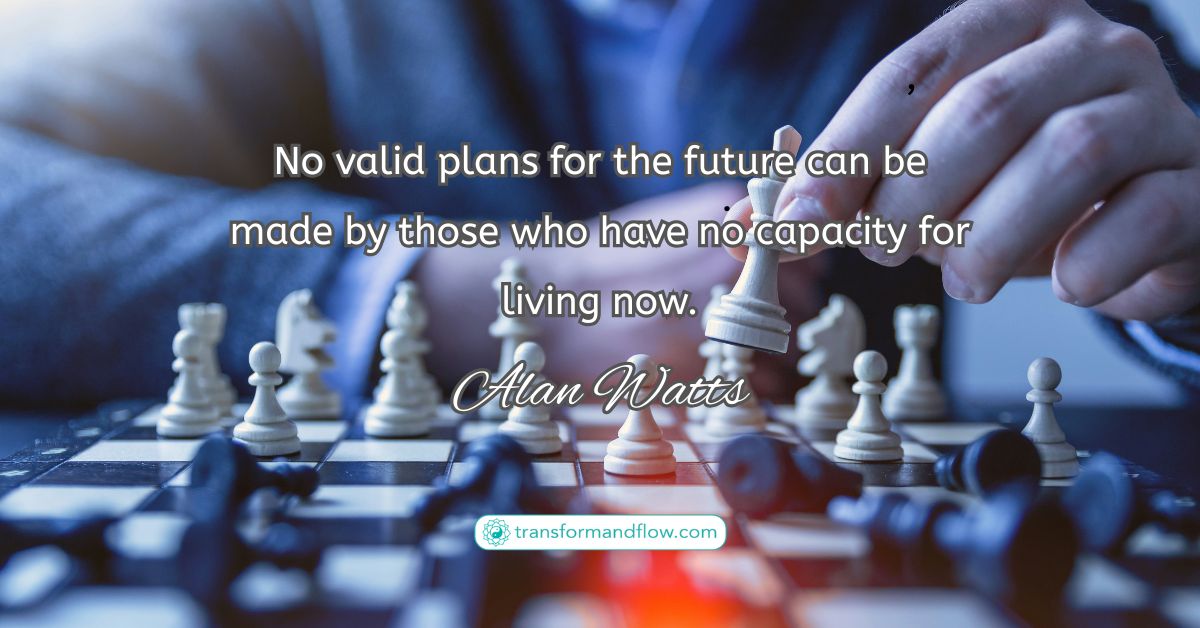
No valid plans for the future can be made by those who have no capacity for living now. Alan Watts
Modern research validates Watts’ insight.
The Cognitive Limits of Planning
Psychologists have found that chronic stress and anxiety, often rooted in anticipation of the future, reduce working memory, decision-making capacity, and creativity. When someone is consumed by fear of “what’s next,” their brain literally struggles to hold the pieces necessary to create effective plans.
In contrast, mindfulness practices, which train the brain to return to the present, improve executive function and emotional regulation. A 2011 Harvard study using fMRI scans showed that mindfulness increases activity in the prefrontal cortex, the very part of the brain responsible for long-term planning. Ironically, focusing on now strengthens the ability to prepare for later.
Flow States and Creativity
Mihaly Csikszentmihalyi’s research on “flow” describes the deep immersion people experience when they are fully present in a task. Athletes, artists, and scientists often report breakthroughs when they lose themselves in the moment. From this state, innovative ideas and future strategies arise – not from anxious projection but from complete presence.
Comparative Example: Stressful vs. Grounded Planning
- Scenario A: A student, overwhelmed with anxiety about failing a final exam, spends weeks worrying rather than studying effectively. Their “planning” consists of sleepless nights and scattered notes.
- Scenario B: Another student practices mindfulness, grounds themselves in daily study sessions, and attends to rest and nutrition. Their plans for exam preparation are rooted in presence, leading to more effective outcomes.
The same principle applies in businesses, relationships, or health. Planning rooted in stress leads to burnout; planning rooted in presence leads to resilience.
The Paradox of Planning: How Living Now Shapes Tomorrow
Alan Watts was not against planning. He was against illusion. His warning is that plans made without presence are like castles built on sand. They might look impressive, but they lack foundation.
Mindfulness as the Bridge
Mindfulness, whether approached spiritually or scientifically, is the art of cultivating presence. It is not passivity; it is engagement.
- In a spiritual sense, mindfulness aligns with meditation, prayer, or contemplative walks.
- In a scientific sense, mindfulness reduces stress hormones like cortisol, improves focus, and increases gray matter density in areas related to self-awareness and compassion.
Both views converge: the more present you are, the more reliable your future plans become.
The Balance Between Now and Later
Living now does not mean abandoning the future. It means understanding that the future is an extension of the present. As Thích Nhất Hạnh wrote, “The future is made of only one substance: the present moment.”
From a scientific perspective, time is not something we “arrive at” but a continuous process. Neuroscientists studying the brain’s perception of time note that our sense of self is constructed in real-time. What we call “future” is a projection of current neural activity.
Thus, the most effective way to shape the future is to fully inhabit the present.
Practical Steps: Cultivating Presence to Plan Better
- Mindful Breathing – Before making major plans, take five minutes to breathe deeply and notice sensations. This centers the mind.
- Ground in Facts, Not Fears – Ask: What is actually happening right now? Base decisions on current realities, not imagined catastrophes.
- Daily Rituals – Farmers, monks, and athletes alike know that consistent daily practices (watering, meditating, training) create long-term results.
- Reflect Often – Journaling about today’s experiences clarifies tomorrow’s intentions.
- Embrace Uncertainty – Both spiritual and scientific traditions affirm that uncertainty is inevitable. Presence allows us to respond flexibly instead of clinging rigidly to a fragile plan.
Conclusion: The Future Is Now in Disguise
Alan Watts’ quote invites us into a paradox: by living fully now, we plan better for later. Plans without presence are hollow; presence without direction is scattered. But when the two meet – presence grounding vision – we create futures worth living into.
The Buddha called it “the middle way,” balancing acceptance with effort. Neuroscientists call it “executive functioning,” enhanced through mindfulness. Watts called it the art of living now.
In the end, the future is nothing more than today’s choices unfolding. To build wisely, we must first inhabit the ground beneath our feet.