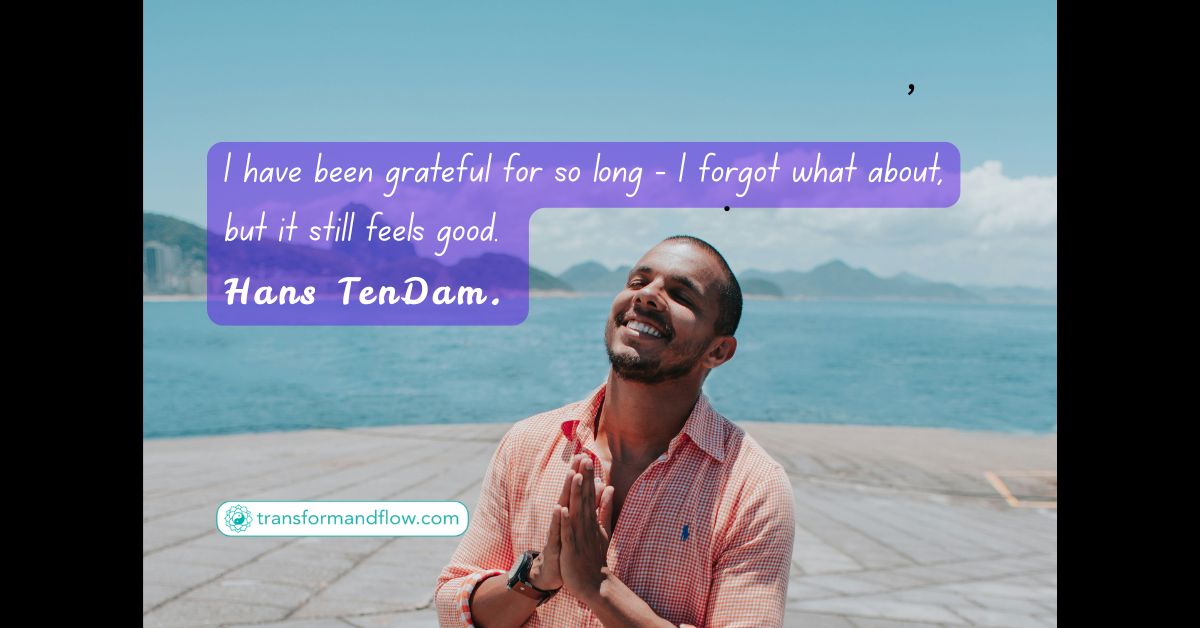
I have been grateful for so long – I forgot what about, but it still feels good. Hans TenDam.
At first glance, this quote sounds playful, even slightly absurd. How could someone be grateful without remembering why? Gratitude, after all, is usually tied to something specific: a person, an event, a breakthrough, a blessing that stands out against the ordinary flow of life. Yet the longer we sit with Hans TenDam’s words, the more profound they become. They point to a state of being rather than a reaction—a way of living where gratitude is no longer dependent on circumstance, but has become a habit of consciousness.
This kind of gratitude does not wait for proof. It does not negotiate with the future or tally up the past. It simply is. And in that quiet, persistent presence, it becomes a powerful force for shaping how we think, how we choose, and ultimately, how we manifest our reality.
Awareness: The Human Superpower
One of the most extraordinary abilities humans possess is awareness – our capacity to observe our own thoughts, emotions, and impulses. We are not merely swept along by instinct. We can notice an urge, pause, and decide whether or not to act on it. This ability to step back from our inner world gives us freedom that few other species enjoy.
Yet awareness alone is not enough. What matters is what we do with it.
Most of us spend much of our lives reacting automatically. A comment triggers defensiveness. A setback revives an old fear. A familiar pattern repeats itself, even when we know it no longer serves us. Awareness gives us the chance to interrupt these loops. It creates a small but powerful gap between stimulus and response – and in that gap lies choice.
Gratitude plays a remarkable role here. When we cultivate gratitude, even imperfectly, it becomes an anchor that brings us back into the present moment. Instead of being hijacked by old stories or future anxieties, we notice what is here now. And from that grounded place, awareness becomes actionable.
Overriding Impulses and Building New Habits
Change rarely happens in dramatic leaps. It happens in small, almost invisible steps. Each time we override an impulse, choosing patience over irritation, curiosity over judgment, gratitude over complaint, we take a baby step toward a new way of being.
Habits are not formed by grand intentions but by repeated choices. Gratitude, when practiced consistently, becomes one of the most transformative habits we can develop. At first, it may feel forced or artificial. We may consciously list things we are thankful for, even when life feels heavy. But over time, something shifts. Gratitude stops being something we do and starts becoming something we are.
This is what Hans’s quote points to. When gratitude has been practiced long enough, the mind no longer needs an object to justify it. The nervous system recognizes gratitude as a familiar state – safe, expansive, and nourishing. The feeling remains, even when the reason fades into the background.
And from this place, our habits begin to change naturally. We respond differently. We speak differently. We make choices aligned not with fear or scarcity, but with trust and openness. These small changes compound, shaping the reality we experience day by day.
Freedom from the Past and the Future
Many of our decisions are quietly biased. Past experiences whisper warnings: Don’t try that again – you were hurt last time. Fears about the future urge us to control outcomes that have not yet arrived. While these mental shortcuts are meant to protect us, they often limit us instead.
When we live primarily through the lens of the past or the future, clarity becomes elusive. The present moment is clouded by memory and anticipation. Our decisions are reactive rather than intentional.
Gratitude offers a way out of this loop. By drawing our attention to what is already working, already meaningful, already alive, gratitude grounds us in the now. It does not deny past pain or future uncertainty, but it refuses to let them dominate the present.
From this grounded place, the quality of our decisions improves. We are less defensive, less rushed, less driven by the need to avoid discomfort. Instead, we respond with discernment. We listen more deeply. We choose with a sense of alignment rather than urgency.
This clarity is not loud or dramatic. It often arises from stillness – a quiet mind that is not constantly replaying old narratives or rehearsing imagined futures. Gratitude naturally invites this stillness. It slows us down enough to see clearly.
The Still Mind and the Gift of Clarity
A still mind is not an empty mind. It is a spacious one. In stillness, thoughts may arise, but they are not gripping. Emotions may pass through, but they do not overwhelm. This inner quiet allows insight to surface without force.
Gratitude supports this state beautifully. When we are genuinely appreciative, the mind softens. The incessant need to fix, judge, or compare relaxes. We are no longer scanning for what is missing. We are present with what is.
From this stillness comes clarity – not the rigid certainty of ego, but a gentle knowing. We begin to sense what feels right and what does not. We recognize when an opportunity aligns with our values and when it is driven by fear or validation-seeking. Decisions made from this place tend to feel lighter, even when they are challenging.
This clarity is one of the great, often overlooked benefits of gratitude. It is not merely an emotional uplift; it is a cognitive and intuitive enhancement. It sharpens perception by quieting the noise.
Gratitude as a State of Joyful Being
When gratitude matures, it becomes less about appreciation for specific outcomes and more about a joyful relationship with life itself. We begin to appreciate people not for what they provide, but for who they are. We appreciate moments not because they are extraordinary, but because they are fleeting and real.
In this state, life feels less like a problem to solve and more like an experience to participate in. Joy arises not from constant happiness, but from a deep sense of inclusion – nothing is excluded from our capacity to appreciate. Even difficulty is met with curiosity and respect.
This does not mean bypassing pain or pretending everything is positive. Rather, it means holding life with a wider embrace. Gratitude allows us to say, This too belongs. And in doing so, we reduce resistance, which is often the true source of suffering.
Living this way naturally changes how we interact with others. Appreciation replaces entitlement. Compassion replaces comparison. Relationships deepen, not because they are perfect, but because they are seen and valued.
Gratitude and the Language of the Universe
Many spiritual and metaphysical traditions suggest that the universe responds not to what we say we want, but to the state we consistently embody. Gratitude, especially when it is no longer conditional, sends a clear and coherent signal.
When we are grateful, we are effectively saying: This is the frequency I choose to live in. We are no longer broadcasting lack or desperation. We are not fixated on what must change before we can feel fulfilled. Instead, we are demonstrating trust.
This clarity is powerful. Gratitude refines intention. It strips away mixed messages and internal contradictions. When appreciation becomes our default state, the universe, or life itself, receives a clean impression of what we value and what we are ready to receive.
Manifestation, in this sense, is not about forcing outcomes. It is about alignment. Gratitude aligns our thoughts, emotions, and actions with a sense of wholeness. From that alignment, opportunities arise naturally. People, ideas, and circumstances seem to meet us with less friction.
Forgetting the “What” and Remembering the “How”
Returning to Hans’s quote, there is something liberating about forgetting what we are grateful for. It suggests that gratitude has moved beyond transaction. We are no longer keeping score. We are no longer saying, I’ll be grateful if…
Instead, gratitude becomes a way of moving through the world. It is reflected in how we pause, how we listen, how we choose. It shapes our habits quietly and persistently.
This is where manifestation becomes effortless. Not because everything goes our way, but because we meet whatever comes with openness and appreciation. Life feels less adversarial and more collaborative.
In the end, gratitude is not about remembering every blessing. It is about remembering ourselves – our capacity to choose awareness over autopilot, clarity over fear, and joy over resistance. When we live from that place, gratitude no longer needs an object. It becomes its own reward, and the foundation upon which a meaningful, manifest life is built.