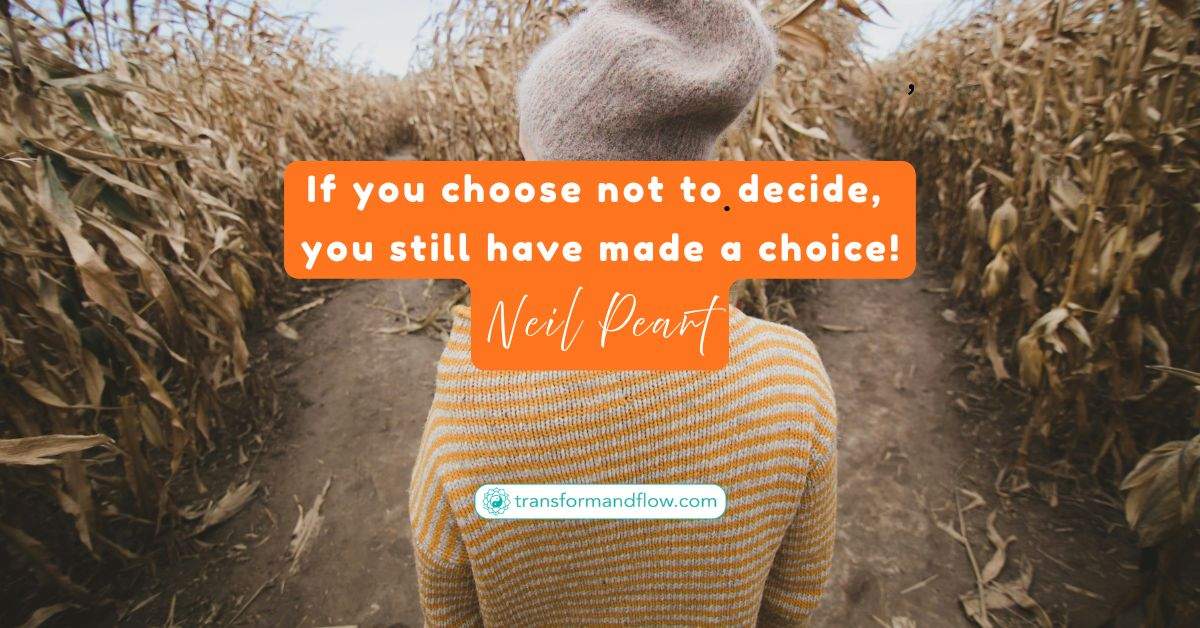
“If you choose not to decide, you still have made a choice!” Neil Peart
Neil Peart, the legendary drummer and lyricist for the band Rush, was not just a musician; he was a philosopher of the highest caliber. When he penned the line, “If you choose not to decide, you still have made a choice,” he wasn’t merely writing a catchy hook. He was identifying a fundamental law of existence that acts as a pivot point for our mental health, our spiritual growth, and our physical reality.
In my practice, I see this dynamic play out daily. Clients come to me feeling “stuck,” “blocked,” or victimized by circumstance. They often feel they are waiting for a sign, waiting for the “right time,” or waiting for the world to align before they make a move. They believe they are standing still in a safe zone of neutrality.
But Peart reminds us: Neutrality is an illusion.
Let’s dissect this profound wisdom to understand why the “choice of no choice” is often the most dangerous one we can make, and how embracing the power of decision can liberate us from the unchangeable past.
The Anatomy of “The Void”
We tend to view decision-making as a binary switch: Choice A or Choice B.
- Do I take the job, or stay?
- Do I end the relationship, or commit?
- Do I eat the salad, or the burger?
When the options feel overwhelming, or the fear of making the “wrong” mistake paralyzes us, we retreat into A Void of Indecision. We tell ourselves, “I’ll think about it later,” or “I’m just going to see what happens.” Psychologically, this feels like a pause button. We believe we have stopped the film. But in the theater of life, the projector never stops running.
When you retreat to The Void, you are effectively handing the steering wheel of your life over to external forces. You surrender to Entropy, the natural tendency of things to decline into disorder. You give Other People—spouses, bosses, or society—the authority to dictate your path. Most dangerously, you allow Old Patterns to take over, letting your subconscious programming (often rooted in childhood) run on autopilot.
By choosing not to decide, you are choosing to be a passenger in your own existence. This passivity is the root of much anxiety and depression. The soul knows it is meant to be the driver; when it is relegated to the backseat, deep spiritual friction occurs.
The Neuroscience of Limbo
From a scientific perspective, indecision is metabolically expensive and neurologically stressful. Our brains are prediction machines. They crave certainty. When we leave a decision unmade, we create what psychologists call an “Open Loop.”
Think of your brain like a computer. Every unmade decision is an application running in the background, eating up RAM and draining the battery. The Zeigarnik Effect suggests that people remember uncompleted or interrupted tasks better than completed ones. While this helps waiters remember drink orders, in life, it means your subconscious is constantly churning over these unmade choices, leading to mental exhaustion.
The biological cost of not deciding is significant:
- Decision Fatigue: Even the act of postponing a decision requires willpower, depleting the energy needed for actual action.
- Elevated Cortisol: Uncertainty triggers the amygdala (the fear center), keeping your body in a low-grade fight-or-flight state, which impacts your immune system and sleep.
- The Neuroplasticity of Passivity: Neurons that fire together, wire together. Every time you hesitate and retreat, you strengthen the neural pathways of avoidance. You are literally training your brain to be passive.
Neil Peart’s lyric cuts through this biological fog. It reminds us that there is no “timeout.” The brain is either directed by your conscious intent, or it is directed by the chaos of the environment.
A Spiritual Perspective: The Law of Free Will
In Transpersonal Regression Therapy, we often explore the concept of the soul’s journey. We look at the lessons we intended to learn in this lifetime. The fundamental mechanism of this “earth school” is Free Will.
Free Will is not just a right; it is a responsibility. It is the muscle by which we grow. When we look at challenges through a spiritual lens, we see that the universe is constantly asking us: “Who are you now?” Every moment is a question, and your response is your life.
When you “choose not to decide,” you are attempting to opt-out of the curriculum. You are refusing to answer the universe. However, the Law of Cause and Effect (Karma) does not pause. Action creates a reaction, but inaction also creates a reaction—usually stagnation, decay, or the accumulation of pressure until a crisis forces a change.
Many can trace their current suffering back not to a “wrong” turn, but to a refusal to turn at all. They see a version of themselves ten years ago, standing at a crossroads, paralyzed by the fear of the unknown. Because they didn’t choose, the road crumbled beneath them, and they fell into a path they never wanted.
The spiritual truth is this: You cannot avoid the stream of life. You can swim, or you can float. If you float, you will go where the current takes you—often into the rocks. If you swim, even against the current, you are building spiritual strength and defining your own destiny.
The Illusion of “The Perfect Choice”
Why do we choose not to decide? Usually, it is because we are terrified of making the wrong choice. We want a guarantee. We want to see the future before we commit to it.
This is a misunderstanding of how reality works. Quantum physics offers a beautiful metaphor here. In the quantum realm, particles exist in a state of probability (a wave function) until they are observed. The act of observation collapses the wave into a particle—a definite reality.
Decisions are the “observations” of our lives. Until you decide, your future is just a hazy cloud of probabilities. Nothing is real. By deciding, you collapse the wave function. You make a reality solid.
Here is the secret: There are no “wrong” choices.
There are only choices and consequences, followed by new choices.
- If you make a decision and it leads to a desired outcome: You celebrate.
- If you make a decision and it leads to an undesired outcome: You learn.
Growth happens in both scenarios. Stagnation only happens in the third scenario: Indecision. When you realize that “failure” is just data—feedback from the universe helping you course-correct—the fear of deciding evaporates. You realize that the only true failure is the refusal to participate in the experiment of your life.
Breaking the Chains of the Past
How does this relate to the “unchangeable past”?
Many of us are stuck in indecision today because of trauma from yesterday. We made a choice in the past, got hurt, and vowed, “I will never put myself in that position again.” We equate safety with stillness.
You cannot change the past. But you can change the momentum of the past; reframing these memories can never change the event, but it can change the conclusion drawn from the event.
- Old Conclusion: “I chose, and I got hurt. Therefore, choosing is dangerous.”
- New Conclusion: “I chose, and I learned a painful but valuable lesson. Now I have more wisdom to make a better choice today.”
If you stop deciding today, you are letting the past dictate your future. You are letting the ghost of who you were hold hostage the person you are becoming.
To decide is to cut the cord. The word “decide” comes from the Latin decidere, meaning “to cut off.” When you make a real decision, you cut off the other options, but you also cut off the drag of the past. You step into the “Now.”
Practical Steps: Moving from Passive to Active
So, how do we apply Neil Peart’s wisdom to our daily lives? How do we stop “choosing not to decide”?
1. Identify Your “Open Loops” Take an inventory. Where are you stalling? Is it your health? A difficult conversation? A career move? Acknowledging the indecision is the first step.
2. Embrace the “Good Enough” Decision Perfectionism is just procrastination in a fancy suit. Stop waiting for the perfect solution. As General George Patton said, “A good plan violently executed now is better than a perfect plan executed next week.” Trust that you can handle the outcome.
3. Trust Your Somatic Wisdom Often, our analytical mind is the source of the blockage. Our bodies, however, usually know the answer. Teach yourself to tune into your “gut feeling.” When you think of Option A, does your chest expand or contract? Does your stomach clench or relax? Your body is a finely tuned antenna; use it.
4. The 2-Minute Rule If a decision takes less than two minutes to execute (answering an email, throwing away the junk food, signing up for the gym), do it immediately. This builds the “decision muscle” and clears the mental RAM.
5. Rewrite the Narrative Instead of saying, “I don’t know what to do,” start saying, “I am in the process of gathering data to act.” But set a deadline. “I will gather data until Friday at 5 PM. At 5:01 PM, I decide.”
Conclusion: The Symphony of Will
Neil Peart’s drumming was renowned not just for its technical complexity, but for its intentionality. Every beat, every rest, every fill was a deliberate choice. He didn’t just let the sticks fall; he commanded them.
Your life is your solo. It is your composition.
If you sit behind the drum kit of your life and refuse to hit the skins because you’re afraid of missing a beat, you aren’t playing music. You have chosen silence. You have chosen to let the background noise drown you out. You have chosen to be a victim of circumstance rather than a creator of destiny.\
Look at the areas of your life where you have been “choosing not to decide.” Forgive yourself for the delay—it was a protective mechanism. But recognize that you have outgrown that protection.
Take a breath. Connect with that deep, transpersonal part of yourself that knows why you are here. And make a choice. Any choice.
The past is unchangeable, but the future is unwritten. The pen is in your hand. Decide.