
In an age obsessed with external markers of success and happiness – grand achievements, material wealth, perfect relationships – the voice of Marcus Aurelius, the Roman Emperor and Stoic philosopher, cuts through the noise with startling clarity.
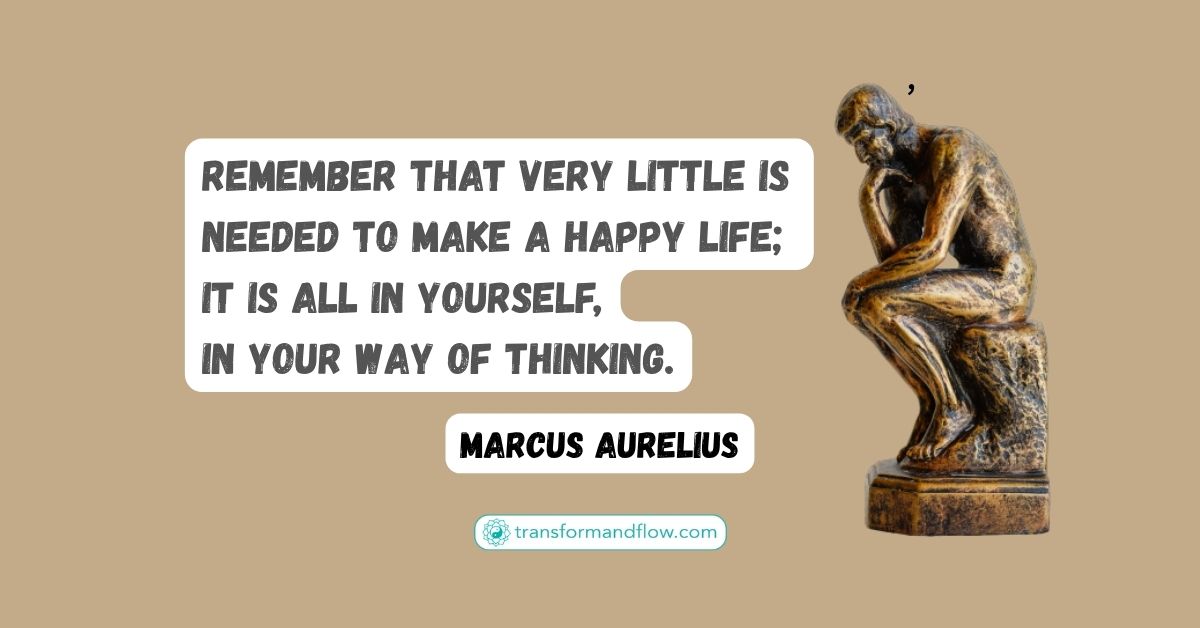
Remember that very little is needed to make a happy life; it is all in yourself, in your way of thinking, Marcus Aurelius
Not merely a philosophical platitude, but a profound and practical guide to cultivating enduring contentment, it suggests that happiness isn’t a destination reached through external means, but a state of being meticulously constructed from within.
Aurelius’s wisdom, penned in his personal meditations, challenges the conventional notion that our circumstances dictate our joy. Instead, he posits that true felicity springs from our perception, our mindset, and our deliberate choices about how we engage with the world. This idea is more relevant than ever in our modern, often overwhelming, lives.
The Tyranny of the External: Why We Seek Happiness in the Wrong Places
From a young age, we are subtly, and sometimes overtly, conditioned to believe that happiness is something we acquire. We chase promotions, bigger houses, newer gadgets, more thrilling experiences, and idealized relationships, convinced that these external additions will complete our picture of contentment. Marketing campaigns perpetually reinforce this narrative, equating product ownership with profound satisfaction. Social media, too, fuels this illusion, presenting curated snapshots of seemingly perfect lives that leave us feeling perpetually inadequate and in pursuit of the next “thing.”
This relentless pursuit of external gratification leads to a dangerous cycle:
- The Hedonic Treadmill: We adapt quickly to new pleasures. That new car or promotion brings a surge of joy, but soon, it becomes the new normal, and we’re left craving the next upgrade.
- Vulnerability to Fortune: When our happiness is tethered to external factors—a job, a person, possessions, health—we become incredibly vulnerable to the whims of fate. When these things inevitably change, break, or depart, our happiness crumbles.
- Constant Dissatisfaction: The focus on what we don’t have perpetuates a state of longing, making it impossible to appreciate the abundance that already exists in our lives.
Marcus Aurelius, having ruled one of the largest empires in history, had access to virtually every external comfort and power imaginable. Yet, his writings reveal a profound understanding that none of these external trappings guaranteed inner peace. He knew that true happiness had to be forged in the crucible of one’s own mind, impervious to the fluctuating tides of the outside world.
The Stoic Blueprint: Cultivating Happiness from Within
Aurelius’s philosophy, Stoicism, is not about suppressing emotions or living an austere life. Rather, it’s a practical framework for virtue, reason, and resilience. It provides specific tools for reshaping our “way of thinking” to foster happiness:
- The Dichotomy of Control: This is perhaps the most fundamental Stoic principle. Aurelius consistently reminded himself (and implicitly, us) to distinguish between what is within our control and what is not. Our actions, thoughts, judgments, and reactions are within our control. External events, other people’s opinions, health, weather, fate—these are not. True freedom and peace come from focusing our energy solely on what we can control. “You have power over your mind – not outside events. Realize this, and you will find strength.”. By releasing the futile struggle against uncontrollable circumstances, we free up immense mental and emotional energy.
- Perception and Judgment: For Aurelius, events themselves are neutral; it is our judgment of them that makes them good or bad. “If you are distressed by anything external, the pain is not due to the thing itself, but to your estimate of it; and this you have the power to revoke at any moment.”. This radical idea empowers us. A missed flight isn’t inherently “bad”; it’s an inconvenience. Our anger or frustration comes from our judgment of it as unfair or catastrophic. By re-evaluating our initial judgments, we can transform our emotional experience.
- The Practice of Negative Visualization (Premeditatio Malorum): This isn’t about dwelling on negativity, but proactively contemplating potential misfortunes. By mentally rehearsing difficulties (e.g., losing a job, illness, betrayal), we reduce their shock value if they occur and cultivate a deeper appreciation for what we have now. It steels us against adversity and highlights the transient nature of external blessings.
- The Impermanence of All Things (Memento Mori): Aurelius frequently meditated on the fleeting nature of life and all its phenomena. Recognizing that everything is temporary—successes, failures, loved ones, even life itself—fosters a sense of urgency to live virtuously and a detachment from outcomes. It helps us appreciate the present moment and reduces fear of loss. “Think of yourself as dead. You have lived your life. Now, take what’s left and live it properly.”.
- Amor Fati (Love of Fate): This powerful concept encourages us not just to accept, but to love everything that happens, good or bad, as necessary threads in the tapestry of our lives. It’s about seeing obstacles as opportunities for growth and adversity as a chance to practice virtue. This isn’t passive resignation but an active embrace of reality.
Very Little is Needed: Examples in Action
Aurelius’s principle that “very little is needed to make a happy life” finds resonance across diverse experiences, proving that this isn’t just theory, but a practical path to contentment.
Consider the story of Victor Frankl, an Austrian neurologist and psychiatrist, and a Holocaust survivor. Imprisoned in Auschwitz and other concentration camps, he endured unimaginable suffering, starvation, and the loss of his entire family. Every external comfort, every freedom, every vestige of his former life was stripped away. By all conventional measures, his life was a living hell, devoid of any reason for happiness. Yet, Frankl’s observations and his personal experience led him to develop Logotherapy, centered on the belief that humans are driven by a “will to meaning.” He found that even in the most dehumanizing conditions, those who cultivated an inner purpose – whether observing nature, recalling a loved one, or simply finding a reason to survive for a future goal – were more likely to endure. He focused on the freedom that could not be taken away: the freedom to choose one’s attitude in any given set of circumstances. Frankl’s story powerfully illustrates that happiness, or at least a profound sense of purpose and meaning, can indeed be forged solely in one’s “way of thinking,” even when “very little” is left.
Another compelling example is Helen Keller. Born deaf and blind at 19 months old, her early life was characterized by immense frustration, isolation, and violent outbursts. Her “reality” was one of profound sensory deprivation, seemingly a perpetual barrier to any semblance of a happy or fulfilling life. Yet, through the dedicated work of her teacher, Anne Sullivan, Keller learned to communicate, unlocking her brilliant mind. She chose to focus not on what she lacked, but on what she could learn, achieve, and contribute. She became a prolific author, an influential political activist, and a lecturer, traveling the world to advocate for people with disabilities. Her happiness wasn’t contingent on regaining sight or hearing; it was meticulously built through her intellectual curiosity, her unwavering determination, her pursuit of knowledge, and her deep sense of purpose in helping others. She fundamentally transformed her internal landscape, proving that “very little” external input could still lead to an extraordinarily rich and joyful existence.
These examples underscore that happiness is not about the absence of problems, but the presence of a robust inner framework that allows us to interpret and respond to life’s inevitable challenges with resilience and a sense of agency.
Cultivating Your Inner Architect of Happiness: Action Steps
Marcus Aurelius’s wisdom isn’t passive; it’s a call to active mental training. Here’s how you can start reshaping your “way of thinking” to cultivate a happier life:
- Practice the Dichotomy of Control Daily:
- Action: When you encounter a challenge or a source of worry, pause. Draw a line down a page (mental or physical). On one side, list what is within your control (your effort, your attitude, your response). On the other, list what is outside your control (the weather, other people’s actions, past events).
- Goal: Consciously shift your focus and energy only to the “within your control” side. Let go of the rest. This practice, done consistently, reduces anxiety and increases your sense of empowerment.
- Challenge Your Judgments:
- Action: When you experience a strong negative emotion (anger, frustration, sadness), identify the thought or judgment that triggered it. Ask yourself: Is this truly an objective fact, or is it my interpretation? What’s another way to look at this situation? Is this judgment serving me?
- Goal: Reframe negative situations. For instance, a traffic jam isn’t “ruining my day”; it’s an opportunity for a forced pause, a chance to listen to a podcast, or practice patience.
- Embrace Mindfulness and Presence:
- Action: Happiness resides in the present moment. Practice mindfulness through meditation, conscious breathing, or simply focusing fully on one activity at a time (e.g., truly tasting your food, listening attentively to a loved one).
- Goal: Reduce rumination about the past and anxiety about the future. By fully engaging with the “now,” you uncover the richness that often goes unnoticed.
- Cultivate Gratitude:
- Action: Each morning or evening, list 3-5 things you are genuinely grateful for. These don’t have to be grand gestures; they can be simple pleasures like a warm cup of coffee, a kind word, or good health.
- Goal: Shift your focus from scarcity to abundance. Gratitude trains your mind to recognize and appreciate the “very little” that is often overlooked but profoundly contributes to happiness.
- Practice Detachment from Outcomes (Amor Fati):
- Action: When pursuing a goal, give your full effort, but practice detachment from the specific outcome. If things don’t go as planned, ask: “What can I learn from this? How can I grow?” Embrace the twists and turns as part of your unique path.
- Goal: Reduce the fear of failure and increase resilience. Loving your fate means accepting all experiences as opportunities for learning and becoming.
Conclusion: The Unconquerable Mind
Marcus Aurelius’s timeless declaration, “Remember that very little is needed to make a happy life; it is all in yourself, in your way of thinking,” is not a dismissive wave of the hand at life’s challenges. Instead, it is an empowering manifesto. It reminds us that while external circumstances may fluctuate, our inner landscape remains our sovereign territory.
Happiness is not a prize to be won in the external world, but a garden to be cultivated within the mind. By diligently tending to our thoughts, refining our perceptions, and focusing on what we can control, we build an unshakeable inner fortress of contentment. In a world that often feels chaotic and overwhelming, this ancient wisdom offers profound solace and a practical roadmap to a life filled with purpose, resilience, and genuine joy—a life truly lived, irrespective of its external trappings. Embrace the power of your own mind; it holds the key to a happy life.